
Three booked jobs. If each one earns you about $1,200 in profit, that’s what it takes to pay back door hanger delivery to 2,500 homes. Math like that keeps traditional marketing methods on the table for local businesses in 2026. Not every old-school channel holds up the same way, though. Some let you pick the streets, prove the work happened and trace the phone calls. Others ask you to take it on faith. We’ve been walking neighborhoods since 2001, so here’s how we’d sort them and how to run a campaign you can measure.
Key Takeaways
- Traditional marketing methods still convert when you can aim them at chosen neighborhoods, verify delivery and trace the response.
- Door hangers cost more per home than mail, and that price buys front-door placement with GPS-tracked, photo-verified proof.
- EDDM postcards carry USPS retail postage of $0.26 per piece and need no mailing list, which makes them a natural second channel.
- Divide campaign cost by profit per job before you launch, and you’ll know exactly how many sales you need to break even.
- Give every neighborhood its own code or phone number so your next round of budget follows the streets that called.
What Is Traditional Marketing, and Does It Still Convert?
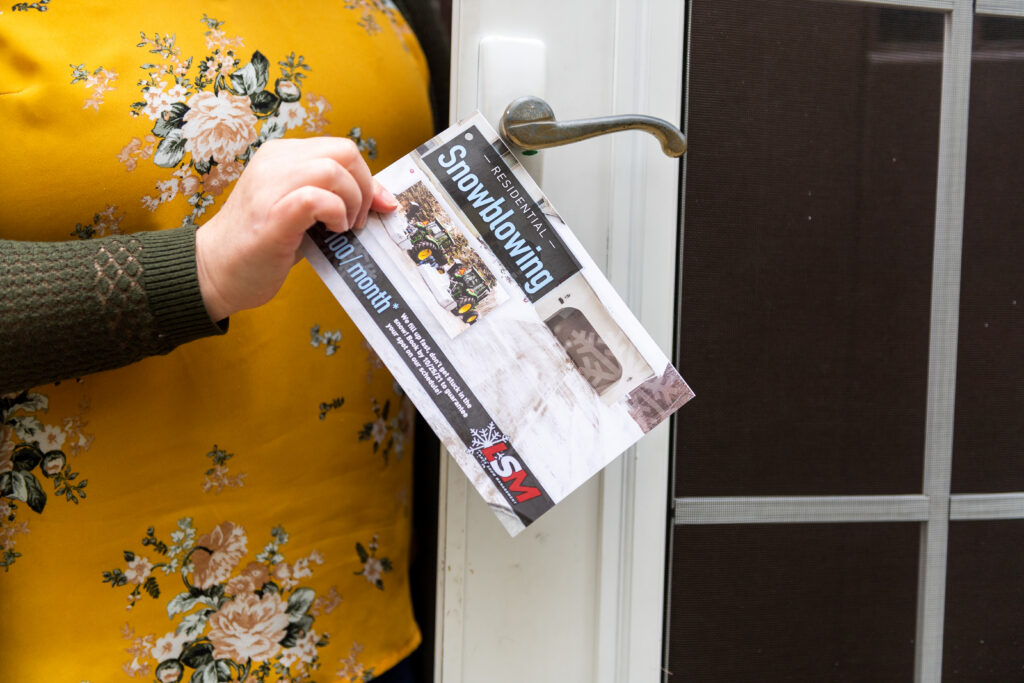
Traditional marketing is any promotion that reaches people offline, including door hangers, direct mail, print ads, radio, TV commercials and billboards. Yes, traditional marketing methods still convert, and they do it most reliably when a real person holds the piece in their hands and has a reason to act this week.
A 2015 neuromarketing study from the USPS Office of Inspector General and Temple University found people moved through digital ads faster but spent more time with physical ones, felt a stronger emotional response and remembered them better. One of our customers put it more simply in a Google review: “Analog is the new digital!”
Attention alone doesn’t pay the bills, though. Before you spend a dollar on any of these traditional marketing tactics, ask three questions:
- Can you choose the neighborhoods, zip codes or routes it reaches?
- Can you prove it actually ran or landed?
- Can you connect a phone call or booking back to it?
Three yeses gives you a channel you can tune. Two means you’re buying awareness, which is fine as long as you know it.
Which Traditional Marketing Methods Still Convert for Local Businesses?
The traditional marketing methods that convert most reliably for local businesses are the ones you can aim by neighborhood, which puts door hangers and EDDM postcards at the front. Radio and billboards work well for broad brand awareness across a metro, and local newspapers depend on how strong the paper still is in your area.
| Channel | Good fit for | How you aim it | Proof and tracking |
|---|---|---|---|
| Door hangers | Saturating chosen neighborhoods | Neighborhood, zip code or route, every door | GPS and photo proof, unique code or number |
| EDDM postcards | Blanket coverage at a lower cost per home | USPS carrier routes, every mailbox | USPS delivery, unique code or number |
| Radio | Metro-wide brand awareness | Station and time of day | Station airing logs, dedicated number |
| Billboards | Repeat exposure on busy roads | Location and traffic pattern | Placement photos, short web address |
| Local newspapers | Towns with an active community paper | The paper’s circulation area | Printed copy of the ad, coupon code |
Door hangers and postcards pass all three questions. Hand delivery costs more per home than mail. EDDM postcards reach every address on the routes you pick, with no mailing list to buy. USPS lists EDDM Retail postage at $0.26 per piece. Postcards are also handy for gated communities, apartment complexes and strict HOA areas.
Radio reaches 93% of U.S. adults each month, according to coverage of Nielsen’s 2026 Audio Today report. Outdoor advertising has momentum too, with U.S. out-of-home revenue up 10.7% to $3.16 billion in the second quarter of 2026. Both are solid traditional advertising choices when you serve a whole metro. Work a few zip codes, and your marketing budget pays to reach plenty of people you can’t serve.
Newspapers deserve a local check. Medill counted 136 U.S. newspaper closures in its 2025 report, more than two a week. Where a healthy community paper still lands on porches, print ads can do nice work. Ask for current circulation by zip code first.
Why Door Hangers Lead Our List of Traditional Marketing Methods
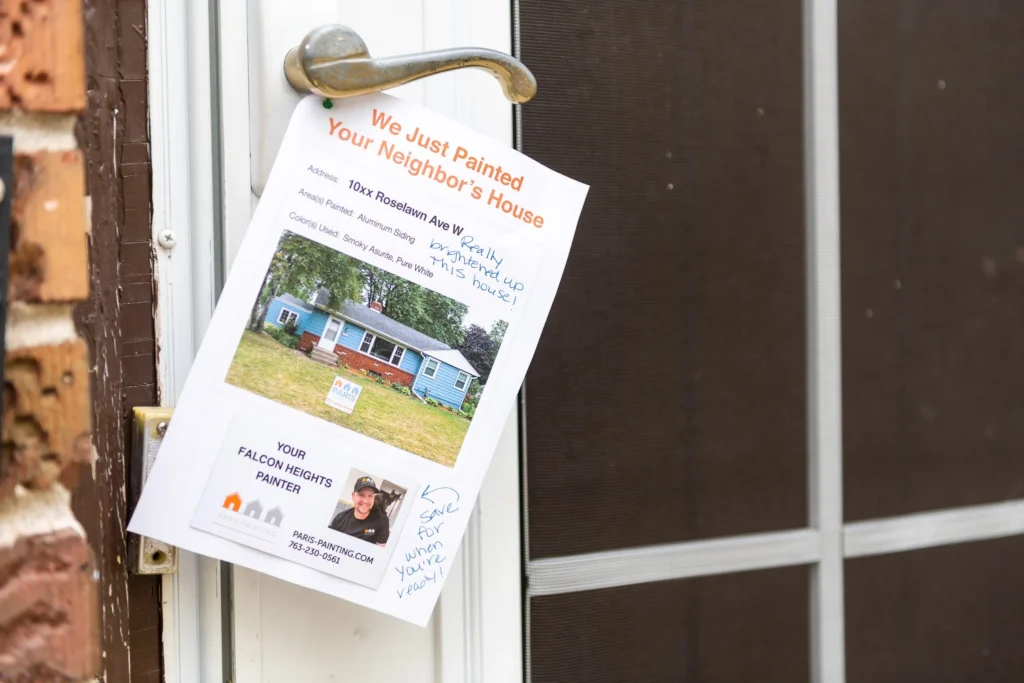
Door hangers lead our list of traditional marketing methods because they land on the front door, where someone has to pick them up, and every route can be documented. You choose the neighborhoods, and we deliver to every home in that area, with GPS tracking and photo verification on each route.
Our door hanger distribution service starts from $0.99 per home. Every delivery contractor carries a GPS and a camera, each piece gets secured with a rubber band, and you receive route maps and photo verification when the work is done. You can see your marketing happened, street by street.
We deliver in Minneapolis, St. Paul, Des Moines, Las Vegas, Phoenix, Salt Lake City, Portland, Seattle, Fargo and Sioux Falls, and a test of 2,500 to 5,000 homes gives you enough to read. Thinking about doing it yourself? Federal law prohibits putting unstamped circulars in a mailbox to avoid postage, so hangers stay on the door and anything bound for the box goes through the post office.
Our look at door hanger distribution vs direct mail goes head to head, and our roundup of offline marketing strategies covers vehicle wraps, sponsorships and more.
How Do You Track ROI on Traditional Marketing Methods?
You track ROI on traditional marketing methods by setting a break-even number before launch, giving each area its own response path and comparing booked jobs against campaign cost. It’s simple arithmetic, and it tells you quickly whether a neighborhood deserves another round or your budget belongs somewhere else.
- Find your break-even by dividing campaign cost by profit per job. Delivery to 2,500 homes at $0.99 to $1.20 runs $2,475 to $3,000 before printing, so at $1,200 profit per job, three jobs cover it.
- Split the map, and give each neighborhood its own promo code, phone number or landing page.
- Make one clear offer with a real deadline.
- Return to the same streets for more than one round before you judge the results.
- Move next round’s money toward the areas that called.
Someone who finds your door hanger on Tuesday and searches your name on Thursday won’t show up as a door hanger lead in any dashboard, so ask every caller how they heard about you.
Frequently Asked Questions
What are some examples of traditional marketing strategies?
Common traditional marketing examples include door hangers, flyers, direct mail postcards, newspaper and magazine print ads, radio spots, TV commercials, billboards, sponsorships and trade shows. For most local service businesses, the most useful traditional marketing channels are the ones that reach homes in a defined area.
What is the difference between digital and traditional marketing?
The difference in traditional marketing vs digital marketing comes down to where the message lives. Traditional marketing reaches people through physical or broadcast media like mail, door hangers and radio, while digital marketing reaches them through screens, search and social platforms. Small businesses can happily run both.
Will digital marketing replace traditional marketing?
We don’t expect digital marketing to replace traditional marketing, because each one does a different job. Digital catches people already searching for you, while door hangers and postcards reach homeowners who weren’t looking yet. Radio’s monthly reach and rising out-of-home revenue show those channels still hold real audiences in 2026.
How much does door hanger distribution cost?
Door hanger distribution through Paperboy Marketing runs $0.99 to $1.20 per home before printing, and we quote your rate upfront. That price includes GPS tracking and photo verification on every route. Volume discounts are available on larger campaigns, and our guide to choosing a flyer delivery service shows how the numbers add up.
How long should a marketing campaign last?
Plan on at least 90 days for a traditional marketing campaign, with several rounds in the same neighborhoods, so people see your name more than once before you judge it. A few thousand door hangers can often wrap up within a few days, and larger campaigns may take one to two weeks.
Ready to Put Traditional Marketing Methods to Work?
You’ve got the questions, the comparison and the math, so the decision left is which few neighborhoods get your first round. Traditional marketing methods reward businesses that pick a focused area, watch the numbers and go back to the streets that respond.
That’s the part we love. Tell us what you sell and where your favorite customers live, and we’ll map the routes, quote your per-home rate and show you what your proof of delivery will look like. Call (612) 217-2737 or request a quote for your first campaign.